
What Is Purim? The Story, Customs, and 2027 Date
What is Purim? The Book of Esther story, costumes, hamantaschen, and mishloach manot food gifts, the most gift-focused Jewish holiday. Begins March 22, 2027.
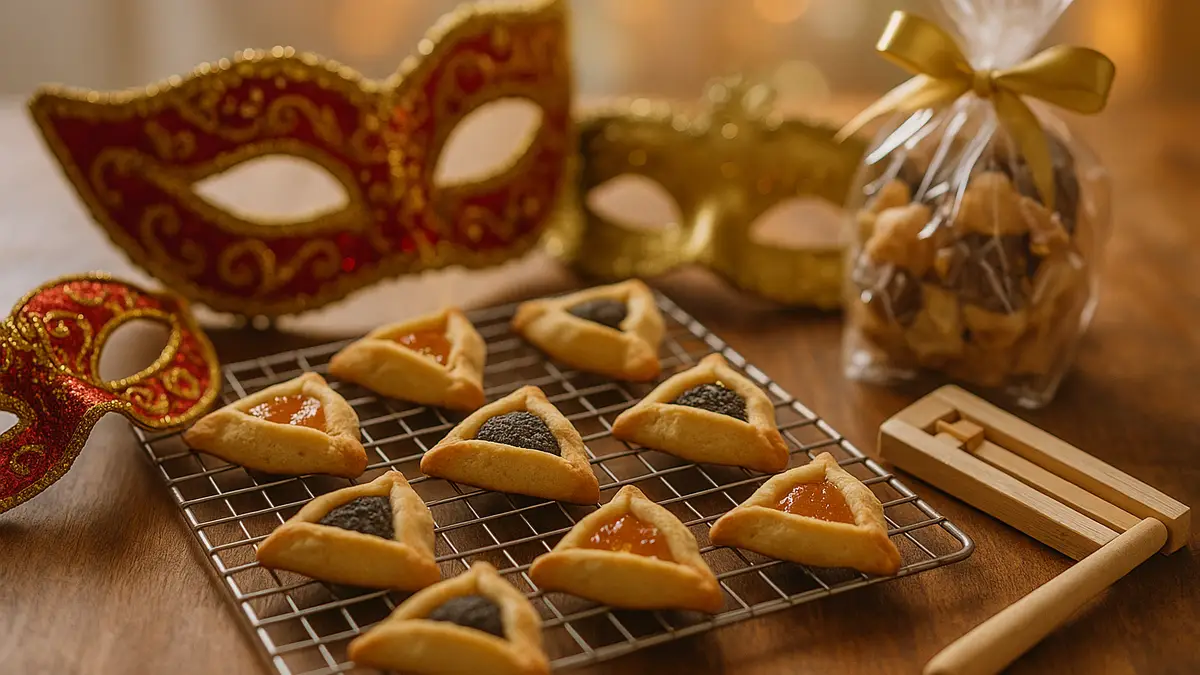
If Hanukkah is the Jewish holiday Americans know best, Purim might be the one they’re most surprised by once they learn it: costumes, noisemakers, cookies shaped like a villain’s hat, and an actual gift-giving custom that predates Hanukkah’s by centuries. Here’s the story and the traditions behind it.
What is Purim, exactly?
Purim is a joyful, rabbinically established Jewish holiday commemorating the events in the biblical Book of Esther, when the Jewish community of the ancient Persian empire was saved from a plot to destroy them. Unlike Rosh Hashanah, Yom Kippur, or the pilgrimage festivals, it isn’t a work-restricted holiday, it’s a single festive day, marked by costumes, a public reading, and genuine celebration rather than reflection. In 2027 it begins at sunset on March 22 (some walled cities, notably Jerusalem, celebrate a day later, on what’s called Shushan Purim).
What’s the story behind Purim?
The Book of Esther is set in the Persian empire under King Ahasuerus, who removes his queen, Vashti, for refusing a royal command and eventually chooses a new queen: Esther, a Jewish woman who, on the advice of her cousin and guardian Mordechai, keeps her Jewish identity hidden. Meanwhile, the king’s advisor Haman, furious that Mordechai won’t bow to him, convinces the king to authorize the destruction of the empire’s Jewish population.
Mordechai urges Esther to intervene, and she does, risking her life by approaching the king uninvited and eventually revealing her identity and pleading for her people. The king reverses course, Haman is executed on the gallows he built for Mordechai, and the Jews of Persia are given the right to defend themselves, turning near-catastrophe into celebration. That reversal, a story that could have ended in disaster instead ending in deliverance, is the emotional center of the holiday.
What are the four mitzvot of Purim?
Purim observance centers on four specific obligations for the day, and unlike most holidays, one of them is literally about gift-giving.
| Observance | What it involves |
|---|---|
| Megillah reading | Hearing the Book of Esther read aloud, evening and morning |
| Se’udah | A festive holiday meal |
| Mishloach manot | Giving at least two ready-to-eat food items to at least one friend |
| Matanot la’evyonim | Giving gifts, usually money or food, to at least two people in need |
Why do people dress up in costumes?
Costumes tie back to the story’s central theme of hidden identity: Esther conceals her Jewish identity for much of the narrative, and, notably, God’s name never appears anywhere in the Book of Esther, the only book of the Hebrew Bible where that’s true. Jewish tradition reads that absence deliberately, as a story about hidden miracles working behind the scenes rather than open, dramatic ones. Costumes and masks became a natural, playful extension of that idea, and Purim celebrations, especially for kids, now often resemble a Jewish Halloween in energy if not in origin.
Where is Purim usually celebrated, at home or synagogue?
Both, and often on the same day. The Megillah reading itself happens at synagogue, typically evening and again the following morning, but the costumes, the festive meal, and the mishloach manot deliveries usually happen around the neighborhood and at home, with kids going door to door in costume in a manner some communities describe as closer to trick-or-treating than to a typical religious observance.
What is a grogger, and why does it get so loud?
A grogger is a noisemaker, traditionally a hand-cranked ratchet, that’s spun loudly every time Haman’s name is read aloud during the Megillah, a tradition meant to symbolically drown out and blot out his name. In a full congregation, this happens dozens of times per reading, turning what could be a solemn recitation into something closer to a rowdy, participatory event, deliberately.
What are hamantaschen?
Hamantaschen are triangular filled cookies, the signature Purim food, traditionally shaped to represent Haman’s three-cornered hat (some traditions say his ears instead). Classic fillings include poppy seed, apricot, prune, and, in modern American kitchens, chocolate, caramel, or fruit preserves of almost any kind.
How do you put together mishloach manot?
Since mishloach manot only requires two ready-to-eat food items sent to one friend, most baskets go well beyond the minimum: think hamantaschen, wine or grape juice, chocolate, dried fruit, and a small treat, packed into a decorated bag or basket and hand-delivered around the neighborhood or synagogue community. It’s genuinely one of the most gift-forward customs in Jewish life, closer in spirit to a holiday gift exchange than most people expect from a religious observance. If you’re building baskets for a group, our Hanukkah gifts guide and unique gifts guide both have ideas that translate well into a Purim basket, and judaica gifts covers nicer, reusable basket and tray options if you want something that outlasts the cookies.
What is matanot la’evyonim?
The fourth Purim observance, and the one most often overlooked next to the fun of costumes and baskets, is matanot la’evyonim: giving directly to at least two people in need, traditionally money, though food or its equivalent value also satisfies the obligation. Unlike mishloach manot, which flows between friends and often becomes a reciprocal exchange, matanot la’evyonim is meant to be one-directional and immediate, many communities collect and distribute it the same day so recipients can use it right away for their own Purim meal.
Before Purim arrives
Purim 2027 begins at sunset on March 22, giving you plenty of runway to plan mishloach manot, a costume, or a hamantaschen batch. For the rest of the calendar around it, including how close Purim sits to Passover, check our Jewish holidays hub for the full year of dates.
Frequently asked questions
Quick answers to what guests ask us most
Why do people dress up in costumes on Purim?
Costumes echo the story's theme of hidden identity: Queen Esther concealed that she was Jewish for much of the story, and God's name never appears anywhere in the Book of Esther, a deliberate textual absence Jewish tradition reads as a story about hidden miracles. Dressing up became a natural, festive extension of that theme.
What is mishloach manot?
Mishloach manot ('sending of portions') is one of Purim's four required observances: giving at least two ready-to-eat food items to at least one friend. It's the closest thing Judaism has to a dedicated gift-basket holiday, and most people give several baskets, not just the minimum one.
What are hamantaschen?
Triangular filled cookies, traditionally shaped to resemble the hat (or, in some traditions, the ears) of Haman, the villain of the Purim story. Poppy seed, apricot, and chocolate are the classic fillings, and they're the single most recognizable Purim food.
Is Purim a work holiday like Rosh Hashanah?
No. Purim doesn't restrict work the way Rosh Hashanah, Yom Kippur, or the pilgrimage festivals do; it's a joyous, rabbinically established holiday, not a biblically mandated day of rest. Most people treat it as a normal workday with an evening or weekend celebration built around it.