
What Is Shabbat? The Jewish Sabbath, Explained
What is Shabbat? It's the Jewish day of rest, sundown Friday to nightfall Saturday, and the reason most bar and bat mitzvahs happen Saturday morning.
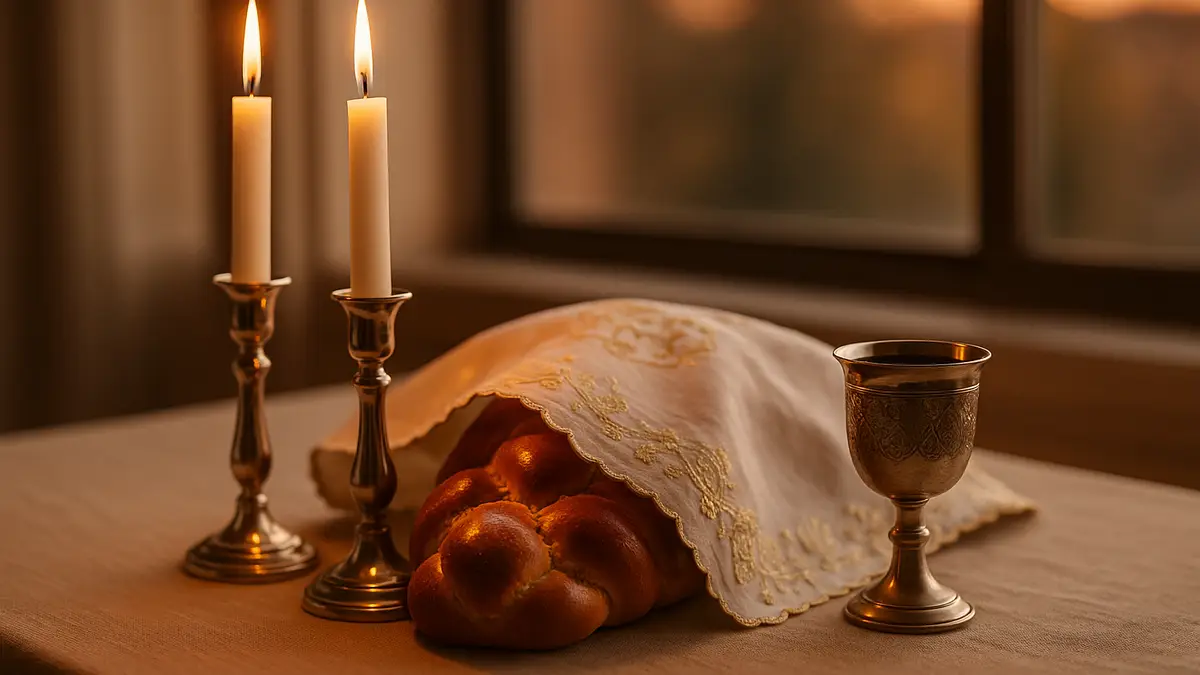
If your invitation says “Shabbat morning service, 10 AM,” you’re not just being told a time, you’re being told which day of the Jewish calendar you’re stepping into. Shabbat is the reason bar and bat mitzvah ceremonies land on Saturdays, and understanding the basics makes the whole morning easier to follow, and easier to not accidentally step on.
What is Shabbat, in one sentence?
Shabbat is the weekly Jewish day of rest, running from sunset Friday to nightfall Saturday, roughly 25 hours, commemorating the biblical account of God resting on the seventh day of creation. It’s the only holiday mentioned in the Ten Commandments, and observant households treat it as the most important recurring event on the calendar, arguably outranking every annual holiday except Yom Kippur.
How does Shabbat begin and end?
Friday evening opens with lighting candles, traditionally 18 minutes before sunset, usually done by the woman of the household though the honor isn’t exclusive to her. Dinner follows with kiddush, a blessing recited over a cup of wine that formally sanctifies the day, and a blessing over two loaves of braided challah bread, the double loaf recalling the double portion of manna the Israelites gathered before Shabbat in the desert. Saturday closes with havdalah, a short ceremony involving wine, spices, and a braided candle, marking the transition back into the ordinary week, and giving the day a clear, deliberate ending rather than just fading out.
Why don’t observant Jews drive or use phones on Shabbat?
Jewish law identifies 39 categories of “work” (melacha) that are set aside on Shabbat, derived from the kinds of labor used to build the ancient Tabernacle: things like lighting a fire, writing, carrying objects in public, and by modern extension, driving a car or completing an electrical circuit. The point isn’t that these activities are exhausting, it’s that stepping back from creating, building, and controlling your environment for one day out of seven is the actual practice of rest. This is why a traditional household won’t answer a phone, run a dishwasher, or get in a car between Friday sunset and Saturday nightfall, and why some hotels near Orthodox neighborhoods install “Shabbat elevators” that stop automatically on every floor so no one has to press a button.
Do all Jewish movements observe Shabbat the same way?
Not even close, and it’s worth knowing before you assume anything about a specific family.
| Movement | Typical Shabbat practice |
|---|---|
| Orthodox | Full observance: no driving, phones, electricity, or money handling |
| Conservative | Widely varies; many follow traditional restrictions, others adapt them |
| Reform | Observance is a personal choice; driving to services and using phones is common |
| Reconstructionist | Similar flexibility to Reform, with strong emphasis on communal ritual |
Practice varies even within a movement and within a single family, so the safest move is to follow what the invitation or the family tells you rather than assume.
Why do most bar and bat mitzvahs happen on Shabbat morning?
The Torah is read publicly four times a week: Monday, Thursday, Saturday morning, and Saturday afternoon, but Saturday morning’s Shabbat service is the longest, best-attended, and most festive, which is why families overwhelmingly choose it for a bar or bat mitzvah. It also means the ceremony is folded into the community’s regular weekly service rather than a special standalone event, tying the child’s milestone to the same prayer service every adult in the room attends every week. For the full order of what actually happens once you’re seated, see what is a bat mitzvah.
What does a typical Shabbat weekend actually look like?
For a family hosting a bar or bat mitzvah, Shabbat often stretches across the whole weekend rather than a single service: a Friday night dinner (sometimes with out-of-town guests included), the Saturday morning service itself, a festive kiddush lunch immediately after, and for some families, a Havdalah-and-party combination Saturday evening once Shabbat has formally ended. Knowing that arc ahead of time helps guests plan travel and figure out which events they’re actually invited to, since not every visitor is included in every piece of the weekend.
What do you bring to a Friday night Shabbat dinner?
If you’re invited to someone’s home for Shabbat dinner rather than a synagogue service, a bottle of kosher wine, a bouquet of flowers, or a box of good chocolate all work well as a hostess gift, handed over on arrival before candle lighting begins. Avoid bringing food that needs to be cooked or reheated once you arrive, since an observant household won’t use the stove or oven again once Shabbat has started, and skip anything that isn’t certified kosher unless you already know the family’s standards.
What should guests know before attending?
If the ceremony is at an Orthodox or traditionally observant synagogue, do not hand the bar or bat mitzvah, or their parents, a cash gift or a card during the Shabbat service or the kiddush lunch that follows, since observant Jews don’t handle money on Shabbat. Bring or send the gift before the event, mail it afterward, or simply hold it until Shabbat ends at nightfall Saturday. Our gift etiquette guide covers timing in more detail, and the synagogue etiquette guide (dress, phones, when to stand) rounds out what to expect once you’re in the room. For the rest of the Jewish calendar Shabbat sits inside, our Jewish holidays hub covers the annual observances that layer on top of this weekly rhythm.
Frequently asked questions
Quick answers to what guests ask us most
What time does Shabbat start and end?
Shabbat begins at sunset on Friday and ends at nightfall on Saturday, roughly 25 hours later, when three stars are visible in the sky. Because sunset shifts with the seasons, candle-lighting times change week to week; most synagogues post the local time.
Why don't observant Jews use electricity on Shabbat?
Traditional Jewish law treats completing an electrical circuit as a form of the 39 prohibited categories of work (melacha) tied to Shabbat rest, so phones, cars, and light switches are avoided by Orthodox and many Conservative Jews. Reform Judaism generally treats these restrictions as optional guidance rather than binding law.
Is it rude to text someone on Shabbat?
It won't offend, but an observant recipient likely won't see it until Shabbat ends Saturday night, so don't expect a reply. If you're coordinating bar or bat mitzvah logistics with an observant family, handle time-sensitive questions before Friday sundown.
Can I take photos at a Shabbat bar mitzvah service?
Often no, if the service is Orthodox or traditional, since operating a camera is treated the same as other prohibited Shabbat work. Reform and many Conservative services allow photography, sometimes only from a hired professional. Check with the family or read our synagogue etiquette guide before you show up with a camera.