
Synagogue Etiquette: A Visitor's Guide
Synagogue etiquette for first-time visitors: kippah, dress code, phones, when to stand, and photography rules, everything you need before a bar or bat mitzvah.
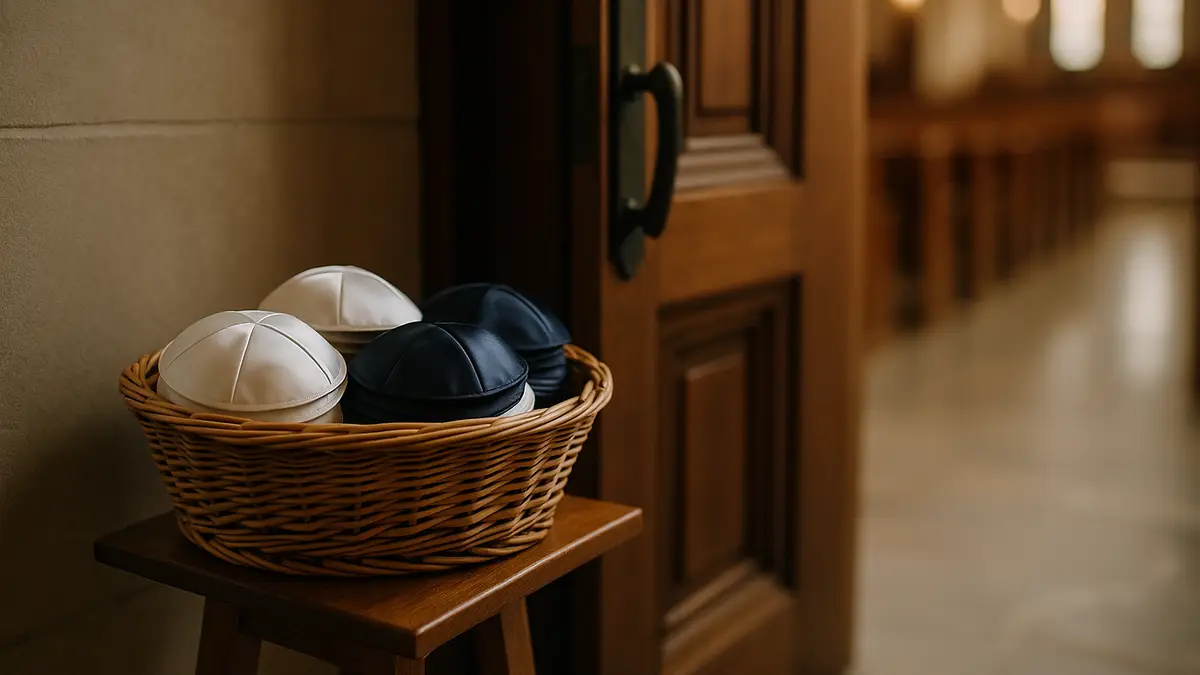
Walking into a synagogue for the first time, most guests are quietly terrified of doing something wrong. You won’t. Nearly every synagogue expects visitors and builds in grace for people who don’t know the choreography, but a few basics will make you feel like you belong in the room instead of bracing for a mistake.
Do I need to wear a kippah?
A kippah (also called a yarmulke) is the small head covering worn during prayer, and most synagogues keep a basket of them at the entrance for anyone who wants one, member or guest, Jewish or not. In Orthodox and many Conservative synagogues, all men are expected to wear one; in Reform synagogues it’s usually optional for everyone. Some Reform and Conservative communities also offer them to women, and a growing number of women wear one by personal choice regardless of the community’s default. Wearing one is a gesture of respect for the space, not a religious statement or a step toward conversion, so when in doubt, take one on your way in.
What should I wear?
Aim for business-dressy: a suit, sport coat, or slacks with a collared shirt for men; a dress, skirt, or dressy separates for women. More traditional synagogues expect covered shoulders and knees, particularly for women; Reform congregations tend to be more relaxed. Skip jeans, shorts, and anything beach-casual unless the invitation explicitly says otherwise, and if the invitation mentions a theme or a specific dress code for the reception, that guidance is for the party, not the service, which still calls for the more conservative option. Our full what to wear to a bat mitzvah guide breaks it down further by season and formality.
Should I turn off my phone?
Yes, fully off or silenced, not just on vibrate, before you walk in. In Orthodox and many traditional synagogues, using a phone during Shabbat services is treated the same as any other prohibited Shabbat activity, so even a glance at a screen can draw attention. Reform synagogues are more relaxed, but a buzzing phone mid-service is a universal faux pas regardless of denomination. If you’re expecting an urgent call, step out to the lobby rather than answering in your seat.
When do I stand up and sit down?
Follow the room. Congregations generally stand for the Torah procession (when the scroll is carried through the aisles), for the Amidah (a core silent standing prayer), and whenever the ark holding the Torah scrolls is open. There’s no printed cue sheet handed to guests, so the easiest strategy is watching the people around you and rising a beat behind them. Most prayer books also print small stand-and-sit icons in the margin for exactly this reason, so a glance at your neighbor’s book can double as a cheat sheet. No one expects a first-time guest to know the choreography cold.
Is it okay to take photos?
Check before you shoot. Orthodox and many traditional Shabbat services prohibit photography entirely, since operating a camera counts as work under Shabbat law; some families hire one approved photographer to shoot discreetly from the back or wait until after Shabbat ends. Reform and Conservative services vary widely, some allow guest photos freely, others restrict it to the reception. When unsure, ask the family or an usher rather than assume, and never use a flash even where photography is technically allowed.
Mixed or separate seating: what will I see?
| Movement | Typical seating |
|---|---|
| Orthodox | Separate seating for men and women, divided by a partition (mechitza) |
| Conservative | Mixed (egalitarian) seating is standard |
| Reform | Mixed (egalitarian) seating is standard |
| Reconstructionist | Mixed (egalitarian) seating is standard |
If you arrive and see a divider down the middle of the sanctuary, you’re at an Orthodox service, sit on whichever side matches your gender and don’t worry about it further.
Is applause appropriate?
It varies by congregation. Some Reform and Conservative synagogues clap warmly after the bar or bat mitzvah finishes their Torah portion or speech; traditional and Orthodox services generally hold all celebration until after the service ends, at the kiddush lunch. If you’re unsure, wait half a beat and see whether the row around you claps first, that half-second delay is the safest tell in the room.
What if I don’t know any of the prayers?
That’s completely normal, and nobody expects a guest to sing along or read Hebrew. Most prayer books used in Conservative and Reform synagogues include English translation and transliteration alongside the Hebrew, so you can follow along silently even without prior knowledge. Standing, sitting, and listening respectfully is a perfectly complete way to participate as a guest.
What if I arrive and don’t know anyone?
Ushers or greeters near the entrance are used to seating unfamiliar faces and will usually point you toward an open row or the section reserved for guests. It’s completely fine to say plainly that you’re a guest of the family and this is your first time in a synagogue, most ushers will actually walk you through what’s coming up next in the service if you ask quietly.
Before you head to the reception
Once the service wraps, the celebration usually moves to a kiddush lunch or an evening party, and that’s typically when cash and card gifts change hands, not during the service itself. Our gift etiquette guide covers exactly when and how to hand over a gift, what happens at a bat mitzvah walks through the full order of the morning if you want to know what’s coming before you sit down, and our broader what is Shabbat guide explains the day itself if the whole framework is new to you.
Frequently asked questions
Quick answers to what guests ask us most
Do I have to wear a kippah if I'm not Jewish?
You're welcome to, and at many synagogues men are asked to; it signals respect, not religious affiliation or conversion. Baskets of kippot (plural) sit at the entrance, take one, no one will ask your religion.
What should I wear to a bar or bat mitzvah service?
Business-dressy: a suit or sport coat for men, a dress or nice separates for women, covered shoulders in more traditional settings. See what to wear to a bat mitzvah for a fuller breakdown by season and venue.
Is it okay to be a few minutes late?
Yes. Shabbat morning services run two to three hours and guests filter in throughout, especially before the Torah reading and the bar or bat mitzvah's part. Slip into a back row quietly rather than skip the morning entirely.
Can I clap after the bar or bat mitzvah's Torah reading?
Depends on the congregation. Reform and many Conservative synagogues clap or even cheer; Orthodox and traditional services generally don't applaud during the service itself, saving celebration for the kiddush lunch after. Watch what the row around you does and follow along.