
What to Wear to a Bat Mitzvah: The Full Guest Guide
What to wear to a bat mitzvah for men, women, teens, and kids: synagogue dress code by movement, party attire, six outfit formulas, and what never to wear.
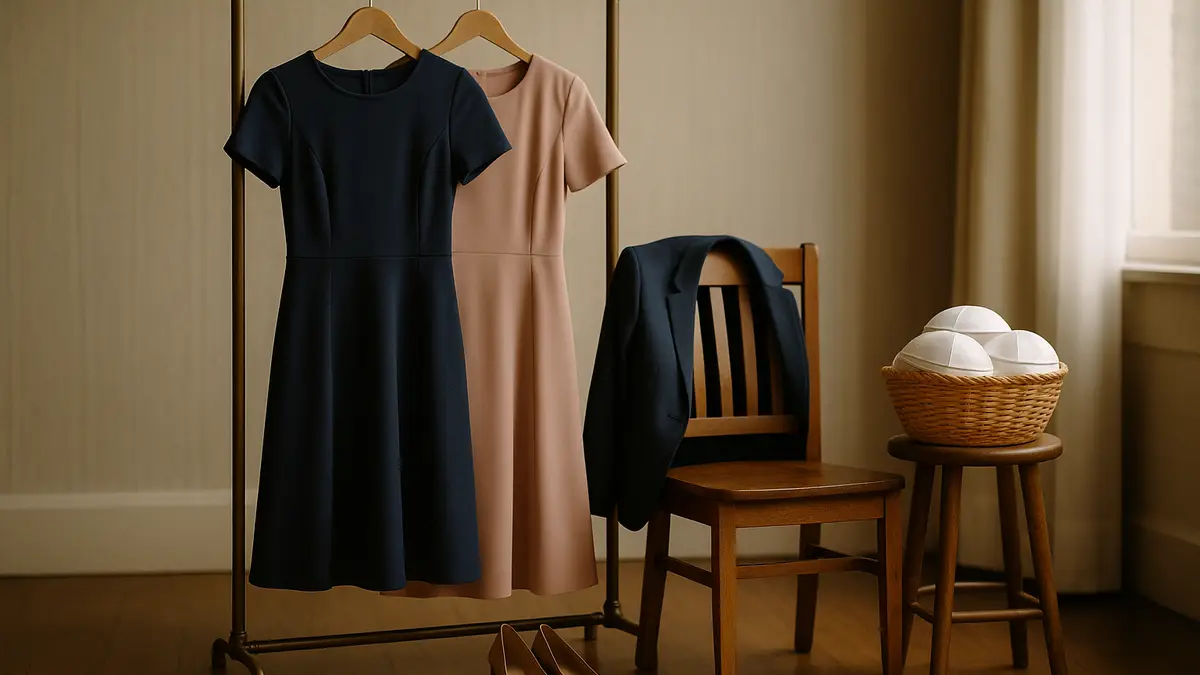
A bat mitzvah invitation is really two dress codes wearing one envelope: the synagogue service in the morning and the party later that day, and they don’t always call for the same outfit. Here’s how to get both right, broken down by who’s wearing what.
The single most important rule: service versus party
Treat the synagogue portion and the celebration as two separate dress codes, because most families do. The service calls for conservative, modest attire suitable for a formal religious setting, regardless of how casual the family is otherwise. The party, whether it’s a backyard lunch or a country-club evening event, follows whatever dress code is printed on the invitation, which can range from casual to black-tie. If the invitation doesn’t specify, default to cocktail attire for an evening party and business-casual for a daytime one, and never assume the party dress code from the synagogue dress code, they’re frequently different.
Synagogue modesty rules by movement
| Movement | Typical expectation |
|---|---|
| Orthodox | Shoulders and collarbone covered, hemlines at or below the knee, sleeves to the elbow, married women often cover their hair; men wear a kippah and sometimes a jacket |
| Conservative | Shoulders covered, knee-length or longer hemlines, men wear a kippah, dress is formal but somewhat more flexible than Orthodox |
| Reform | Business or cocktail attire generally acceptable, modesty expectations are the most relaxed of the three, kippah still customary for men |
A kippah, the small head covering, is offered to men at the entrance of every service regardless of movement or the guest’s own religion, and it’s polite to wear it once inside. In some communities a prayer shawl (tallit) is also offered to Jewish adult men; non-Jewish guests aren’t expected to wear one. Synagogue etiquette covers the broader behavioral rules, standing, sitting, when to speak, alongside dress.
What men should wear
For the service: a suit or sport coat with dress slacks, a collared shirt, and a tie is the safe default across all three movements; Orthodox and many Conservative services lean more formal than Reform ones, so a full suit reads better than a blazer-and-chinos combination if you’re unsure which end of the spectrum the family sits on. For the party: follow the invitation. A dark suit works for cocktail attire; swap in a tie and pocket square for anything black-tie, or lose the jacket for a casual daytime lunch.
What women should wear
For the service: a knee-length or longer dress, skirt, or tailored pantsuit with shoulders covered, a cardigan or shawl solves most modesty gaps if your dress code choice runs sleeveless. Necklines should sit modestly, and very short hemlines or bare shoulders are best saved for the party rather than the sanctuary, especially at Orthodox or Conservative services. For the party: cocktail dresses, jumpsuits, or dressier separates all work depending on the stated dress code; this is where you can go brighter, shorter, or more embellished than you would in the sanctuary.
What teens should wear
Teen guests, especially classmates of the bat mitzvah girl, generally follow the same service-versus-party logic as adults, just with more room for personal style at the party. For the service: a button-down shirt and slacks for boys, a modest dress or skirt-and-top combination for girls, nothing that would draw attention in a formal room. For the party: this is typically the one part of the day where teens can lean into current trends, sequins, bold color, statement shoes, since evening bat mitzvah parties are often built around a teen-friendly dance floor.
What kids should wear
Younger children follow a scaled-down version of the adult rule. For the service: collared shirts and dress pants or shorts for boys, a modest dress for girls, comfortable enough that a young child can sit through an hour or two without a meltdown over an itchy waistband. For the party: something washable and easy to dance in matters more than formality; most hosts would rather see a happy kid in a slightly casual outfit than a miserable one in a stiff one.
Seasonal notes
Bat mitzvahs happen year-round, and the season affects practical choices more than the dress code itself. In summer, breathable fabrics and lighter colors help for an outdoor or midday service, but shoulders still need covering, a light cardigan works better than going sleeveless. In winter, plan for a coat check at both the service and an evening party, and note that many synagogues run warm with a full congregation inside, so layers you can remove beat a single heavy sweater.
Six outfit formulas that work
- Women, service: sheath dress at or below the knee, cardigan, low heel.
- Women, evening party: cocktail dress or jumpsuit, statement earrings, heels.
- Men, service: navy or charcoal suit, tie, dress shoes.
- Men, evening party: same suit, swap the tie for something bolder or drop it for a casual event.
- Teen, service: collared shirt or modest dress, dark slacks or skirt.
- Teen, party: trend-forward outfit appropriate for dancing, comfortable shoes are worth the tradeoff.
What never to wear
Avoid anything sleeveless, low-cut, or above the knee for the synagogue portion, regardless of how casual the rest of the invitation reads. Skip white if the family has hinted at a specific color scheme for the party (rare, but check the invitation). Avoid costume-like or overly casual choices, jeans, sneakers, graphic tees, for the service even if the party later is casual; and never skip the kippah if you’re a man entering the sanctuary, it’s offered for a reason and declining it can read as disrespectful even when unintentional.
Before you finish packing
Once the outfit is settled, the other two guest questions worth nailing down are what actually happens during the service, covered minute by minute in what happens at a bat mitzvah, and how much to give as a gift, broken down by relationship in the bat mitzvah gift amount guide, built on the tradition of giving in multiples of 18.
Frequently asked questions
Quick answers to what guests ask us most
Do I have to cover my head at a bat mitzvah?
Men are customarily offered a kippah at the entrance and are expected to wear it during the service, regardless of religion. Women are generally not required to cover their heads at Reform or Conservative services, though some Orthodox settings expect married women to do so; check with the host if you're unsure.
Can I wear the same outfit to the service and the party?
You can, but many guests bring a change of clothes or accessories, a jacket, statement jewelry, different shoes, to shift from synagogue-modest during the day to more festive for the evening reception, which often has a different dress code entirely.
Is it okay to wear black to a bat mitzvah?
Yes. Black is appropriate for both the service and the party; it's a celebration, not a funeral, so it doesn't carry the same connotation it might elsewhere. Just avoid all-black paired with anything that reads as funeral-formal, like a black veil.
What should kids wear to a bat mitzvah?
The same logic as adults, scaled down: collared shirts and slacks or a knee-length dress for the synagogue service, then something more fun and dance-friendly for the party. See the kids and teens section below for specifics by age.