
Bat Mitzvah Gift Etiquette for Non-Jewish Guests
A reassurance-first guide for non-Jewish guests: how much to give, what's safe to buy, what to avoid, card wording, and what to expect at the service.
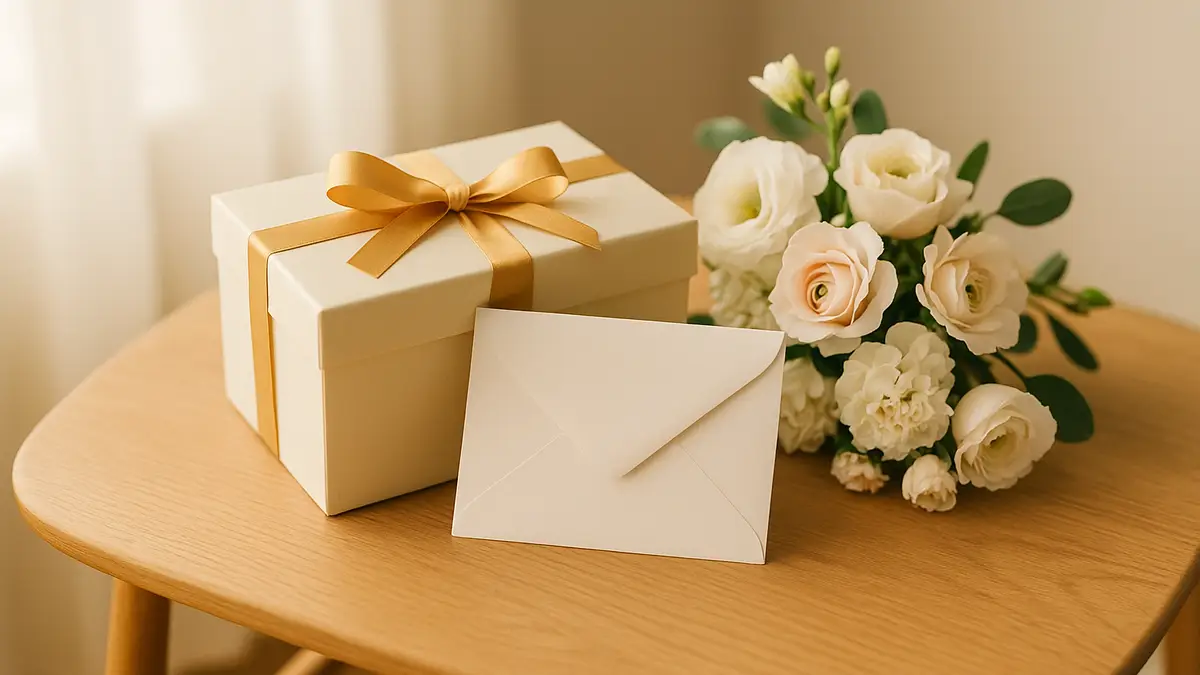
If you’ve been invited to a bat mitzvah and you’re not Jewish, the honest answer to your biggest worry is that you’re going to do fine. You don’t need to know any Hebrew, follow rules nobody taught you, or worry that your gift will look wrong sitting next to everyone else’s. Here’s exactly what’s normal, what to avoid, and what to expect.
Is it normal for a non-Jewish guest to give money?
Yes, completely. Money is the default bat mitzvah gift for every guest, Jewish or not, and the amount follows the same custom everyone else uses: give what you’d spend on a nice birthday gift, rounded to a multiple of 18.
| Your relationship to the family | Typical gift |
|---|---|
| Classmate or teen friend attending alone | $36-$54 |
| Adult friend of the family (per person) | $54-$108 |
| Family invited together | $108-$180 total |
| Relative (aunt, uncle, cousin) | $100-$180 |
| Close family (sibling of a parent, very close friend) | $180-$540 |
Full detail, including how these numbers shift for a formal country-club party versus a simple kiddush lunch, is in the bat mitzvah gift amount guide.
Why multiples of 18?
Chai (חי, life) is the Hebrew word whose two letters add up to 18 in gematria, traditional Jewish numerology, so gifts of $18, $36, or $180 carry a small “life” wish layered on top of the dollar value. It’s a custom, not a rule, a check for $50 won’t offend anyone, but $54 or $36 lands as more thoughtful for the same rough amount. The full explanation is in the chai meaning guide.
Do you need to bring a gift if you’re only attending the service?
If you’re invited to the synagogue service but not the reception afterward, a gift isn’t required, though a card is a nice touch. If you’re invited to the party (the far more common scenario), a gift or money is expected the same as at any other milestone celebration you’d attend.
What if you want to give an object instead of money?
Plenty of safe, welcome options don’t require any religious knowledge: a gift card to a bookstore or her favorite retailer, a nice pen or journal, a photo frame, a plant, a simple piece of jewelry like a birthstone necklace, or a donation to a charity in her name. Keep it neutral, nothing tied to a specific religious tradition, including your own, and you’re on solid ground.
Three things to avoid
- Religious items from another faith tradition. A cross necklace, a saint’s medallion, or a Bible verse gift, even beautifully made, reads as a mismatch at a Jewish milestone. It’s not an insult to offer one, it’s just the wrong occasion.
- Explaining or comparing your own faith’s traditions during the celebration. The day belongs to her tradition. Genuine, curious questions are always welcome; unsolicited comparisons usually aren’t.
- A blank card with no personal line. Even two honest sentences turn a generic card into a specific one, see our card message guide for lines you can copy directly.
What should you write in the card?
“Congratulations” on its own is complete and appropriate. If you’d like to add a Jewish greeting, “Mazel tov” (literally “good luck,” used to mean congratulations) is welcomed from any guest and never seen as presumptuous. Add one true, specific sentence about the honoree, something you admire or a memory you share, and close with a wish for what’s ahead. Full examples by relationship are in the card message guide.
What happens at the service, so you know what to expect
Most bat mitzvah services happen on a Saturday morning as part of the regular Shabbat service and run one and a half to three hours. The honoree reads from the Torah, the Hebrew Bible’s first five books, handwritten on a parchment scroll, and often leads or chants portions of the prayer service. You may be offered a kippah (head covering) at the entrance; wearing one is a respectful option, not a requirement, for a non-Jewish guest, though many synagogues welcome men to wear one regardless. Seating is mixed in most Reform and Conservative synagogues; some Orthodox congregations seat men and women separately, so practice varies by the specific community. You’re not expected to recite prayers in Hebrew, silently standing or sitting along with the room is completely fine. Our full walkthrough of what happens at a bat mitzvah covers the order of the service in detail.
Can you take photos during the service?
Be careful here, it’s an easy accidental misstep. In Orthodox and many Conservative congregations, using a phone or camera during the Shabbat service is against Jewish law’s restrictions on electronics on Shabbat, so photography inside the sanctuary is typically off-limits until the service formally ends. Reform congregations vary, some are fine with it, but when you’re unsure, leave the phone off and tucked away, and take your photos at the reception afterward, where nearly every celebration welcomes them enthusiastically. Many families also hire a professional photographer who has separate, prearranged permission. Our synagogue etiquette guide covers this and a handful of other small things worth knowing before you sit down.
Before you go
Bring a card, keep the gift amount in a multiple of 18 if you’re giving cash, and skip anything tied to another faith tradition. Beyond that, treat it like any milestone celebration for a family you care about, because that’s exactly what it is.
Frequently asked questions
Quick answers to what guests ask us most
Is it rude for a non-Jewish guest to give money instead of a gift?
No, money is the single most common bat mitzvah gift, regardless of the guest's background. Just keep the amount a multiple of 18 (chai, Hebrew for life), see our chai meaning guide for why that number is everywhere.
Do you need to know Hebrew or Jewish customs to attend a bat mitzvah?
No. You'll be handed a prayer book, most services include English translation and page numbers announced aloud, and standing or sitting simply follows whatever the row around you does. Our what happens at a bat mitzvah guide walks through the service.
What should you write in the card if you're not Jewish?
'Congratulations' plus one genuine, specific sentence about the honoree is complete on its own, no Hebrew required. If you want to add it, 'Mazel tov' (congratulations) is welcomed from any guest, see our card message guide for more lines.
What should a non-Jewish guest avoid giving as a gift?
Skip anything with religious imagery from another faith, crosses, saints, scripture verses, and skip explaining or offering your own religious beliefs during the celebration. A gift card, a check, or a neutral, thoughtful item are always safe choices.