
Bar Mitzvah vs Bat Mitzvah: Every Difference Explained
Bar mitzvah and bat mitzvah compared side by side: meaning, age by movement, history, and ceremony format, plus b'nai mitzvah, bas mitzvah, and bat chayil terms.
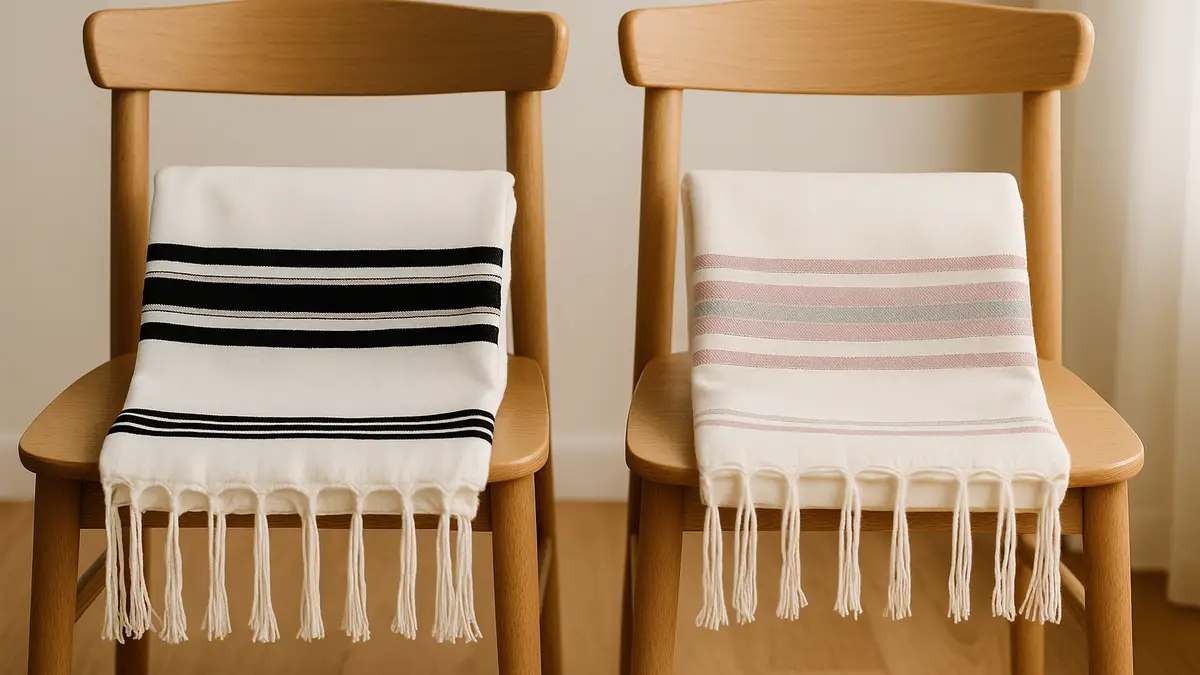
Bar mitzvah and bat mitzvah get used almost interchangeably in casual conversation, “we’re going to a mitzvah this weekend,” but the two milestones differ in meaning, age, history, and, depending on the synagogue, in how the ceremony actually runs. Here’s every difference in one place.
The core comparison
| Bar mitzvah | Bat mitzvah | |
|---|---|---|
| Meaning | Son of the commandment | Daughter of the commandment |
| Who | Boys | Girls |
| Age | 13, every movement | 12 (Orthodox) or 13 (Reform, most Conservative) |
| Origin | Medieval Europe, centuries old | First held in America in 1922 |
| Torah reading | Standard across all movements | Standard in Reform, Conservative, Reconstructionist; varies in Orthodox |
| Ashkenazi pronunciation | Bar mitzvah (unchanged) | Bas mitzvah |
Both describe a status a Jewish child reaches automatically at a specific birthday under Jewish law, not an event you plan and buy tickets to. The ceremony and the party are how families choose to mark the milestone; they don’t create it. Full detail on each side lives in what is a bar mitzvah and what is a bat mitzvah.
Meaning: the words themselves
Bar is Aramaic for “son,” bat is Hebrew for “daughter,” and mitzvah means “commandment.” So bar mitzvah is literally “son of the commandment” and bat mitzvah is “daughter of the commandment,” both describing a person now considered obligated in Jewish law, not exempted the way a minor is. Neither word means “religious ceremony” or “party” on its own, that meaning got attached by common usage over the past century. In precise usage, a child becomes a bar or bat mitzvah on the qualifying birthday; in everyday American English, “having a bar mitzvah” or “having a bat mitzvah” is understood to mean the ceremony and celebration, and both phrasings are fine to use with guests.
Age: the one real point of disagreement
Boys turn bar mitzvah at 13 in every branch of Judaism, no exceptions. Girls are where the movements split. Traditional Jewish law sets female religious majority at 12, tied to classical rabbinic sources on physical maturity, one year earlier than boys. Orthodox communities generally hold to that traditional age. Reform congregations, which have treated boys and girls identically since early in the movement’s history, moved the bat mitzvah to 13 to match the bar mitzvah precisely. Conservative practice varies by congregation, some hold to 12, many now do 13. Bat mitzvah age and bar mitzvah age each go deeper on the reasoning.
Ceremony format by movement
In Reform, Conservative, and Reconstructionist synagogues, the bar mitzvah and bat mitzvah ceremonies are essentially the same event with a different name: a Shabbat morning Torah and haftarah reading, an aliyah, often a short speech from the child. In Orthodox synagogues, the bar mitzvah keeps that same format, but the bat mitzvah usually does not include a Torah reading in the main mixed-gender service, since Orthodox practice does not have women lead those services. Instead, Orthodox families mark a daughter’s 12th birthday with a kiddush, a speech, a father-daughter study program, or in some communities a bat chayil ceremony, a group celebration for several girls together, common in parts of the Orthodox and British Jewish world, that involves readings and presentations but not a Torah reading from the bimah.
History: centuries apart
The bar mitzvah’s roots go back to rabbinic sources from the early centuries of the common era, with the public celebration developing in medieval Ashkenazi Europe. The bat mitzvah has no comparable ancient precedent. Judith Kaplan, daughter of Rabbi Mordecai Kaplan (later the founder of Reconstructionist Judaism), became the first bat mitzvah in America on March 18, 1922, reading from a printed Chumash at the Society for the Advancement of Judaism in New York. Conservative and Reform congregations adopted the practice over the following decades; it’s now close to universal outside Orthodox communities.
Related terms worth knowing
A handful of variations show up around both words:
- B’nai mitzvah: the gender-inclusive plural, “children of the commandment,” used for a group ceremony or when siblings of different genders become bar/bat mitzvah together. Some Reform and Reconstructionist communities also use a related singular, b-mitzvah, for a nonbinary child. Full pronunciation and usage guide in b’nai mitzvah meaning.
- B’not mitzvah: the specifically feminine plural, “daughters of the commandment,” used when a group or pair, such as twin sisters, are all girls.
- Bas mitzvah: the Ashkenazi Hebrew pronunciation of “bat mitzvah,” the same shift that turns “Shabbat” into “Shabbos.” Common in Yiddish-inflected and some Orthodox circles.
- Bat chayil: literally “daughter of valor,” a distinct Orthodox alternative ceremony for girls, typically held as a group event rather than an individual one, and typically without a Torah reading.
Which one are you actually attending?
If the invitation says bar mitzvah, you’re headed to a boy’s ceremony; bat mitzvah, a girl’s; b’nai or b’not mitzvah, a group or sibling event. The mechanics for guests, dress code, gift amount, service structure, run the same regardless of which word is on the invitation. Start with what to wear for the dress code and what happens at a bat mitzvah for the play-by-play, both apply equally to bar mitzvahs. When you get to the gift, the gift amount guide uses the same chai-based, multiples-of-18 math whether the name on the invitation is a boy’s or a girl’s.
Frequently asked questions
Quick answers to what guests ask us most
Which is older, bar mitzvah or bat mitzvah?
Bar mitzvah, by centuries. The custom of marking a boy's 13th birthday with a Torah reading developed in medieval Europe. The bat mitzvah is a 20th-century addition, first held in America in 1922.
Why is bat mitzvah age 12 in some communities and 13 in others?
Traditional Jewish law sets the age of religious obligation at 12 for girls and 13 for boys. Orthodox communities generally keep the traditional age of 12. Reform and many Conservative congregations moved bat mitzvah to 13 to match the bar mitzvah exactly. See bat mitzvah age for the full breakdown.
Is a bat mitzvah a smaller version of a bar mitzvah?
Not in Reform, Conservative, or Reconstructionist practice, where the ceremonies are functionally identical, same Torah reading, same haftarah, same format. In Orthodox practice the bat mitzvah is a genuinely different kind of event, not a diminished bar mitzvah, built around different, though equally sincere, forms of participation.
What do you call it when both a boy and girl become bar/bat mitzvah together?
That combined milestone is usually called a b'nai mitzvah, using the gender-inclusive plural. B'nai mitzvah meaning covers this and related terms like b'not mitzvah in full.